
Purple Paper | March 2026
The Purple Swans© | Michiel Hofstee | Gerard Reumer
Executive summary
On Monday, the CEO says “we’re staying flexible” on pricing and channel design. By Wednesday, EMEA commits to one interpretation to hit targets, APAC builds another to satisfy regulators and North America negotiates exceptions with key accounts. A month later, alignment looks intact on slides — but the business is now running three strategies. When the organization finally “decides,” it is really choosing among narrowed, more expensive options.
Most organizations don’t lose through one catastrophic decision. They lose strategic freedom through repeated postponement of high-stakes choices, especially under uncertainty. This creates Decision-Debt: an accumulated, unpriced liability that builds when leadership defers strategic decisions without explicit decision rights, decision criteria, and decision moment. Teams keep moving anyway, through local interpretations, exceptions, “temporary” assumptions, and parallel builds. The organization pays “interest” in rework, coordination drag, alignment erosion, compliance risk, and option decay. [1][2][3]
Delay can be smart. Real options logic says waiting can create value only when the option is actively preserved (bounded exploration, explicit triggers and reversible commitments). Decision-Debt emerges when delay becomes ownerless, criteria-free, unbounded and spend continues as if a decision exists. In competitive or capacity-constrained environments, delay is often punished by pre-emption: others commit, capture scarce assets and reshape the payoff landscape. [3][5]
This paper operationalizes Decision-Debt with a simple governance tool (the Decision-Debt Ledger) and an executive cadence (compatible with TPS’s Strategic Operating System) that repeatedly converts uncertainty into decision-ready choices before the environment makes the decision for you. [1][6]
1) What Decision-Debt is (and what it isn’t)
Decision-Debt is not “moving slower to be careful.” It is the unpriced liability created when a strategic decision is repeatedly deferred without explicit decision rights, clear decision criteria and a defined decision moment, while the organization continues to spend time/money as if the decision were already made. [2][4]
A practical test:
Decision-Debt exists when:
- a high-stakes choice is deferred, and
- there is no explicit owner, criteria, and decision moment, and
- work continues anyway via workarounds, local interpretations, or “temporary” assumptions.
The interest you pay.
The “interest” shows up as:
- Option decay: good paths close as markets, competitors, talent and partners move. [3][5]
- Cost escalation: later decisions become more expensive (contracting, re-platforming, remediation). [3]
- Rework and drag: teams build, negotiate and plan against shifting assumptions. [2]
- Alignment erosion: different parts of the organization act on different versions of “the strategy.” [4][1]
- Cultural friction: ambiguity becomes normalized; accountability becomes political. [4]
- Fragmentation / local lock-in: regions/functions harden exceptions into de facto policy (the org runs multiple strategies)
- Coordination tax: each exception path creates new interfaces—more handoffs, more negotiations, slower convergence.
- Regulatory and reputational: ambiguous intent triggers local improvisation, increasing compliance and brand risk.
Decision-Debt doesn’t eliminate the decision. It converts it into a later, narrower, costlier decision — often under external pressure. [3][5]
2) Why uncertainty accelerates Decision-Debt
Under uncertainty, leaders face a real tension: Flexibility vs Commitment. Real options theory explains why delaying a commitment can have value — when delay preserves the right to act later with better information and without irreversible lock-in. [3][7][8]
Decision-Debt grows when leaders confuse two very different modes:
Option value of delay (intentional and bounded; owned and criteria-driven; information is actively purchased; and a decision moment is set, and the option is preserved) with
Avoidance delay (unbounded and ownerless, vague criteria; information is passively awaited; and the spend and exceptions continue).
In competitive settings, delay can be punished by pre-emption; rivals commit, capture scarce resources and change the payoff landscape. [5] Under deep uncertainty, decision quality improves when leaders define adaptive triggers, signposts, and contingent actions, not when they simply wait. [6]
Boundary conditions (credibility):
- Not all delay is debt: delay is strategic when criteria and triggers are explicit, exploration is ringfenced and the option is preserved. [3][6]
- Decision-Debt is most dangerous when preemption is possible (competition, talent, partners, scarce capacity) or when global complexity magnifies divergence. [5]
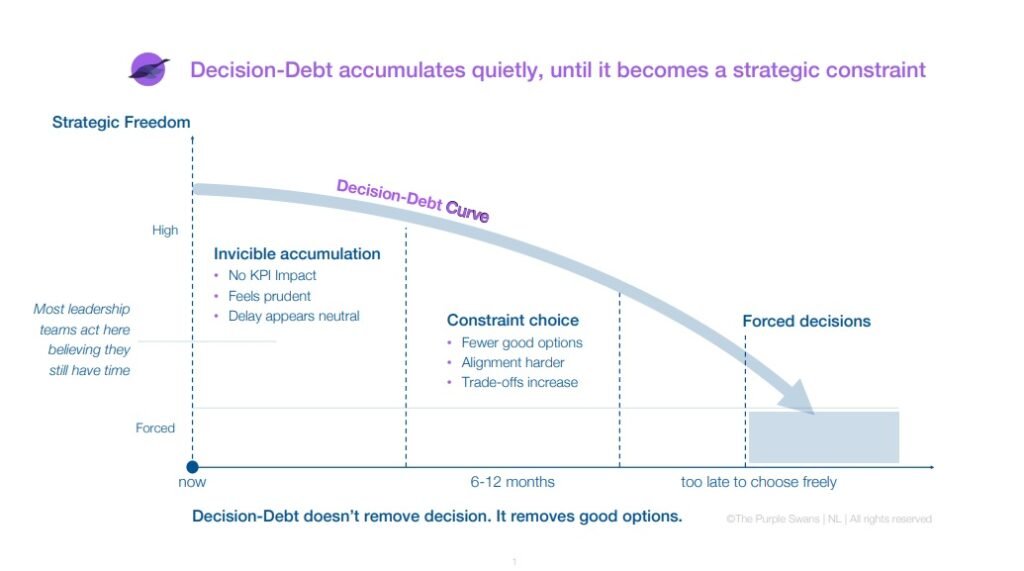
3) The Decision-Debt lifecycle: Drift > Constraint > Forced
Decision-Debt typically moves through three phases:
Phase 1 — Drift (quiet accumulation)
- Meetings substitute for resolution
- “Need more data” becomes the default
- Ownership is unclear; decisions are not recorded as commitments [2][4]
Examples: decision appears in 3+ senior meetings with no recorded commitment, or two or more regions/functions implement incompatible interpretations.
Phase 2 — Constraint (constrained choice)
- Options narrow as external conditions shift
- Alignment degrades; execution slows
- Rework increases (plans revised, budgets re-litigated) [2][3]
Examples: Exception paths exceed an agreed cap or reversibility drops (e.g., contract terms, architecture choices, regulatory filings) such that rollback becomes materially disruptive.
Phase 3 — Event-Driven Choice (forced decision)
- Timing is dictated by events (market moves, regulatory shifts, supply constraints, attrition, crises)
- Choices become binary, expensive, and reputationally visible [3][6]
4) A simple tool: the Decision-Debt Ledger
Treat Decision-Debt like a balance-sheet item: identify it, price it and service it.
4.1 Identify “Decision Liabilities”
List delayed decisions that materially change direction, resourcing or exposure.
Examples:
- build/partner/buy, platform bets, capability gaps
- portfolio pruning, segment entry/exit
- pricing architecture and channel strategy
- operating model changes (centralize vs. federate)
- data/AI governance, cyber posture, compliance design
4.2 Score the interest rate (0–5 each)
For each delayed decision, score:
- Option decay (how fast good options disappear) [3][5]
- Cost escalation (how fast costs rise over time) [3]
- Alignment erosion (how much conflicting direction is emerging) [4][1]
- Execution drag (how much throughput slows / rework grows) [2]
- Irreversibility (how hard it becomes to change later; inverse score) [3]
- Fragmentation / local lock-in (how many divergent implementations are hardening)
Global leadership add-ons (recommended fields):
- Region impact (1–5)
- Regulatory sensitivity (H/M/L)
- Customer impact (H/M/L)
- Talent dependency (H/M/L)
Governance rule: Top 5 Interest Index items must have a decision moment set within 30 days.
4.3 Define a “decision moment” (commit / kill / timebox)
Every liability must resolve to one of three outcomes:
- Commit: decide, resource, and publish the rationale
- Kill: stop explicitly and reallocate capacity
- Timebox: set a hard date + decision criteria + trigger signals [6][3]
A practical enabler is a decision log (decision owner, decision statement, rationale, date, assumptions, triggers, next review). It reduces “phantom re-decision,” supports decision rights clarity, and preserves alignment over time—especially across regions. [2]
5) Preventing Decision-Debt: an operating cadence (compatible with TPS)
Decision-Debt is rarely solved by a one-off offsite. It requires a continuous strategic rhythm that repeatedly converts uncertainty into decision-ready choices. [1][6]
A Decision-Debt-resistant cadence does three things:
A) Maintains a live “Uncertainty → Decision” agenda
- what changed, what it threatens, what it enables
- which decisions are now at risk of option decay [1][6]
B) Separates exploration from commitment
- exploration is timeboxed and criterion-driven
- commitment is explicit, owned, documented, and resourced [3][2]
C) Builds adaptive triggers instead of waiting for certainty
- define signposts, thresholds, and pre-planned actions
- treat strategy as a set of choices with monitored assumptions [6][3]
Executive relevance:
Make this an ExCo operating discipline: a standing agenda item (“Decision-Debt Ledger—Top 5”), explicit decision rights and an auditable trail of commitments, assumptions and triggers. It reduces dependence on heroics or annual planning. [1]
6) Leadership guidance: when delay is smart vs. when it’s debt
Delay is strategic when…
- it preserves meaningful flexibility (a real option)
- competitors cannot easily preempt
- you have explicit criteria and a date/trigger to decide
- you are actively buying information (tests, pilots, structured stress-testing). Not passively waiting [3][5][6]
Delay becomes Decision-Debt when…
- ownership / decision rights are unclear
- criteria are vague (“more data”)
- teams proceed anyway via local interpretation and exceptions
- the same decision returns repeatedly without recorded resolution [2][4]
Three observable indicators (diagnostics):
- the decision appears in 3+ senior meetings with no recorded commitment
- regions/functions implement incompatible interpretations
- “temporary assumptions” keep changing while spend continues
Sticky language leaders can reuse:
- Delay without criteria is not flexibility. It’s drift.
- If teams are executing, you’re already paying interest.
- Timebox means we stop doing the irreversible work until the decision moment.
Conclusion
Decision-Debt is the hidden interest rate organizations pay for postponed choices. Under modern uncertainty, it compounds faster. And in global enterprises it multiplies through local interpretation, coordination tax and regulatory exposure. It shows up later as constrained options, slower execution and cultural friction. [2][3][6]
The solution is not reckless speed. It is decision readiness: a visible ledger, clear decision rights, a disciplined decision moment and a strategic cadence that turns uncertainty into owned choices, before the environment makes the decision for you. [1][6][3]
Addendum A: Decision-Debt anti-patterns (what to kill fast)
- “Need more data” with no data plan, owner, or decision date
- “Let’s pilot” without kill criteria or scale criteria
- Permanent temporary exceptions (exceptions accumulate; policy never arrives)
- Steering-committee loops where escalation replaces decision rights
- Regional discretion without boundary conditions (results: multiple strategies)
Addendum B: Practical paydown moves (monday-morning actions)
- Stop-work rule: freeze irreversible spend above a threshold until owner/criteria/moment are defined
- Single-threaded owner: one accountable decision owner for each Top-5 ledger item
- Exception budget: cap exceptions; require tradeoff disclosure (“what are we sacrificing?”)
- One-page decision memo: statement, options, criteria, assumptions, triggers, and recommendation
- Decision log discipline: publish decisions; reduce re-litigation and “phantom re-decision”
- Trigger-based commitment: define signposts that automatically shift posture (commit/kill/extend)
References
[1] The Purple Swans (TPS). TPS© Strategic Operating System (TPS© Strategic Operating System).
[2] DecisionDesk. “Decision Debt: The Hidden Cost of Decisions Teams Never Finish.” Dated December 30, 2025.
[3] Trigeorgis, L., & Reuer, J. (2017). “Real Options Theory in Strategic Management.” (Widely cited overview of real options as flexibility under uncertainty).
[4] Ballesteros, L., et al. (2018). “Organizational Decision Making Under Uncertainty Shocks.” NBER Working Paper No. 24924.
[5] Weeds, H. (2002). “Strategic Delay in a Real Options Model of R&D Competition.” Review of Economic Studies, 69(3), 729–747.
[6] Stanton, M.C.B., et al. (2021). “Decision making under deep uncertainties: A review of the DMDU literature.” Technological Forecasting and Social Change.
[7] ACCA Global. “Investment appraisal and real options” (technical article explaining delay, staging, and flexibility in investment decisions under uncertainty).
[8] Fowler, M. (2019). “Technical Debt” (explains the debt/interest metaphor and why ‘interest’ shows up as extra effort over time).
[9] Agile Alliance. “Introduction to the Technical Debt Concept.” (background on the debt metaphor’s intent and responsible ‘paydown’).
[10] Software Engineering Institute (SEI), Carnegie Mellon. “A Field Study of Technical Debt.” (context and implications of debt/interest framing in complex systems).