
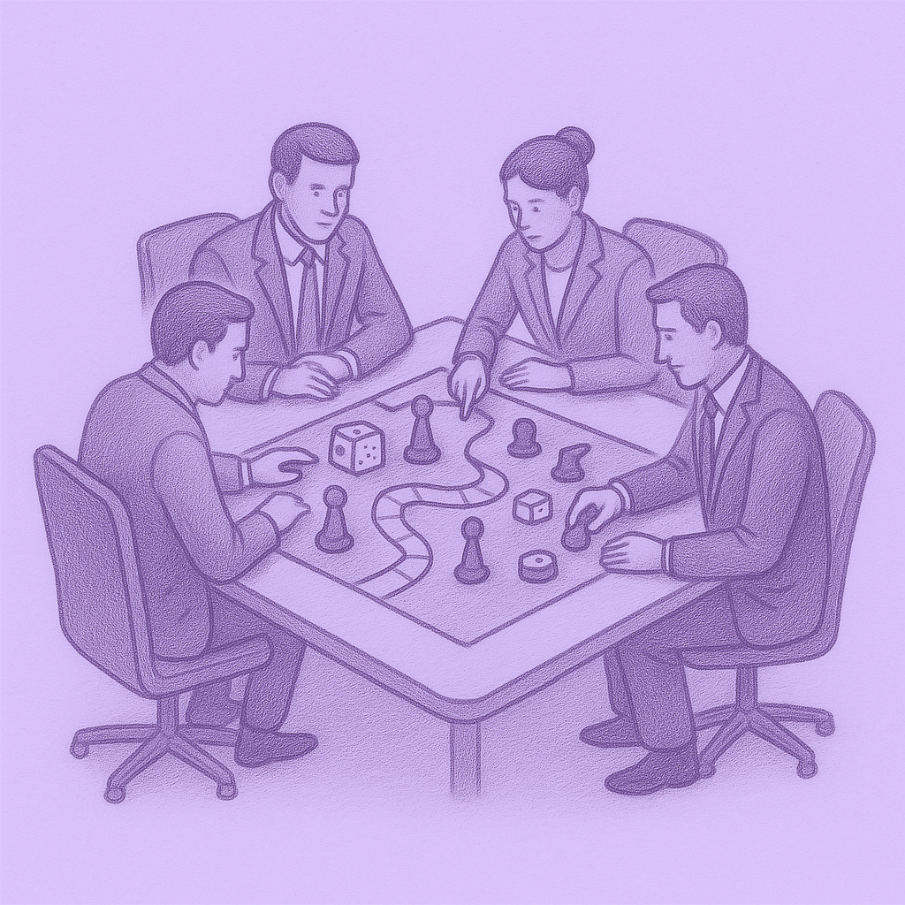
From business simulations to Swan Hunt and the search for disruptive threats
Playing Seriously: How Games Reshape Management Dynamics
Purple Paper | February 2026
The Purple Swans | Gerard Reumer | Michiel Hofstee
Executives rarely describe their most important work as “playing a game.” They talk about strategy, risk, capital allocation, transformation. The tone is serious, sometimes solemn. And yet, more and more often, the moments when leadership teams truly see their business differently happen not in formal board meetings, but in structured game-like settings: simulations, wargames, innovation tournaments, and threat-hunting sessions (1,2,5).
In these settings, the usual choreography shifts. Hierarchies soften for a while. People experiment with decisions they would never dare to propose in a conventional meeting. Assumptions that have lived unspoken for years suddenly become negotiable. For a few hours, an organisation rehearses its future instead of merely discussing it.
This Purple Paper explores the role of such games in management dynamics: what they are, why they are emerging now, what they can do for leadership teams, and where their limits lie. It concludes with a look at Swan Hunt, the game developed by The Purple Swans to help organisations identify and prioritise their most disruptive external threats, and suggests that this kind of “fear-forward” play may be a necessary ingredient of strategy in an age of uncertainty.
What We Mean by “Management Games”
When we speak of “management games” in this context, we are not talking about icebreakers or Friday afternoon team-building. The focus is on serious, structured experiences that borrow the mechanics of games—rules, roles, time-bound rounds, feedback, sometimes scoring or competition—and apply them to questions of leadership, strategy, risk, and innovation (1,2,6).
Some of these games are digital. General business simulations invite teams to run a virtual company over a number of simulated years (2,3,4), making decisions on pricing, capacity, investment, hiring, marketing, and seeing the consequences play out. Function-specific simulations narrow the lens to a particular domain, such as marketing, finance, or supply chain management, but still place players in a competitive environment where their choices interact with those of others (4,6).
Other games are more analogue in nature. Negotiation and leadership role-plays cast participants in scripted or semi-scripted situations—union–management talks, stakeholder disputes, M&A negotiations, difficult performance conversations—and ask them to act them out (1,5). Construction-based methods such as Lego® Serious Play® invite leaders to build physical models of their organisation or their environment and then tell the story of what they have built (7,8,17). Agile and project-management games simulate work flowing through a system, so that participants can feel bottlenecks and the effects of multitasking, rather than merely seeing them on a slide(1,2). Innovation tournaments and hackathon-style events turn idea generation and development into a competition with rounds and pitches (13,14). Ethics and compliance games place players in moral or regulatory dilemmas and show the consequences of different choices. Entrepreneurship board games simulate the evolution of a start-up or business model.
And at the more emergent end of the spectrum, there are threat-hunting and foresight games such as Swan Hunt, in which leadership teams explore disruptive external threats—technological shifts, new entrants, regulatory shocks, social movements—and are challenged to transform those threats into strategic opportunities (15,16).
Different as these formats are, they share a common intention: to change how people in positions of responsibility think, feel, and act together.
Why Games Are Appearing in Boardrooms Now
The increasing presence of games in management is not an accident of fashion. It is a response to the environment in which organisations now operate.
Markets are more volatile, technologies more intertwined, and value chains more globally connected than in the past. Competitive boundaries blur: disruption arrives not only from the familiar rival across town, but from platforms, start-ups, and actors from entirely different sectors. Regulatory regimes can change quickly. Social expectations around sustainability, inclusion, and ethics shift at a pace that traditional planning processes struggle to match.
Classic strategy tools—lengthy reports, tidy forecasts, detailed spreadsheets and slide decks—were designed for a world that was uncertain but broadly modelable. They excel at documenting what is already known and at projecting linear trends forward. They are less effective at helping leaders cope with discontinuities, with surprises, and with the interplay of multiple, interacting risks.
In that context, games offer something that static analysis cannot. They compress time, letting leaders live through several “years” in an afternoon (1, 2). They make complexity tangible by putting participants inside simplified versions of systems rather than above them as observers (1, 6). They create shared experiences—a remembered moment of crisis in round three, a surprise competitor move in a wargame, a sudden collapse of a carefully planned strategy—that travel through the organisation as stories, long after the workshop has ended.
Games also expose something that traditional processes leave hidden: the mental models leaders bring into the room. What do they really believe about how their markets work? About how fast technology will move? About the motives and capabilities of their competitors? About how regulators or citizens will react? These beliefs shape strategic decisions every day, but they are rarely made explicit. Games have a way of dragging them into the light.
How Games Shift Management Dynamics
The most interesting aspect of management games is not the game itself, but what happens to the dynamics among the people who play.
One of the first things that tends to shift is hierarchy. In a conventional meeting, job title heavily influences who speaks when, who gets questioned, and whose ideas are silently parked. In a game, people still know who the CEO is, but for the duration of the exercise everyone is also simply a player, subject to the same rules and time limits (5). That small reframing opens space for different voices. A junior manager may challenge a long-standing assumption because the game demands it. A subject-matter expert may have an opportunity to show their strategic insight rather than merely answer technical questions. Senior leaders, meanwhile, see their teams in a different light: not just as presenters of polished updates, but as actors under pressure, making choices in real time.
Games also change the emotional climate. Real-world decisions carry real-world consequences: capital at risk, jobs on the line, reputations at stake. That can push people toward caution and conformity, especially when very senior leaders are present. In a simulated environment, the stakes are fictional. The game may involve billions of virtual currency, but at the end of the day, no one’s career or balance sheet is actually harmed. This creates a safe-to-fail space where participants can propose radical moves, test extreme strategies, or explore “unthinkable” scenarios without fear. The worst that can happen is losing the game. That loss, in turn, becomes a learning opportunity.
Another powerful effect of games is the way they externalise and test assumptions. When teams are asked to play the role of a competitor in a wargame, they must decide how that competitor will respond to certain moves. Those decisions reveal what they really believe about the competitor’s ambition, culture, constraints, and capabilities. When leaders build models of their organisation with bricks and metaphors, their choices reveal which parts of the system they see as rigid or flexible, central or peripheral. When an agile game prompts participants to overload their virtual board with work-in-progress, their choices show what they truly prioritise when confronted with too much demand.
Because game time is compressed, feedback loops shorten dramatically. Participants can see the consequences of their choices within minutes or hours instead of months or years. A pricing decision in round one leads to changed market shares in round two and cash constraints in round three. An investment in resilience that seemed costly at first suddenly looks wise when a simulated shock hits. As these stories unfold, they force cross-functional conversations that are often more vivid and honest than those held around a status report.
The Upside—and the Shadow Side—of Serious Play
Used thoughtfully, management games bring a number of benefits. They enhance engagement; people are more alert and committed when they are actively deciding than when they are passively being briefed (1, 5, 6). They develop skills in context, so that financial literacy or risk thinking is exercised in situations that resemble real life rather than in isolation (2, 6). They encourage cross-functional understanding, because the game model typically includes several parts of the business and shows how they interact. They help build a shared language: references to “what we did in the simulation” or “how we underestimated that move in the wargame” become shorthand for complex lessons.
Perhaps most importantly, they can deepen foresight. By inviting leaders to inhabit alternative futures, respond to shocks, and watch their strategies succeed or fail in a simulated environment, games can surface vulnerabilities and opportunities that would not emerge from reading a report (10, 11, 12).
None of this makes games a silver bullet. They also come with risks.
The most obvious is oversimplification. There is a thin line between a serious game and a gimmick (4, 10). If the framing is careless, if the design feels childish relative to the gravity of the issues, or if leaders appear to be “playing” with topics such as layoffs, crises, or existential threats, participants may feel alienated rather than engaged. Trust can be damaged when the format seems to downplay real anxieties.
There is also the matter of model risk. Every simulation is an abstraction. Decisions must be made about which variables to include, which to ignore, what ranges of behaviour to allow (4, 6). If these underlying assumptions are poor or biased, the game may reward strategies that would not work in reality, or fail to reveal weaknesses that will matter outside the room. Teams can walk away with a misplaced sense of confidence because they “won” a game that did not reflect the real complexity of their environment.
Another danger lies in the incentives embedded in the game. If the scoring system rewards short-term gains at the expense of long-term resilience, or individual success at the expense of collective outcomes, people may adopt behaviours that are effective in the game but harmful in real life. This is particularly sensitive when games are competitive: the desire to win can push teams toward tactics that send the wrong cultural signal (13, 14).
Psychological safety is a further consideration. While games can create a safe space for experimentation, they can also become performative if not well facilitated. Participants may worry about looking foolish in front of their peers or superiors, especially if results are publicly compared and celebrated. In such an environment, the game may reproduce existing power dynamics rather than disrupt them.
Finally, there is the “workshop graveyard” problem. Many organisations have a long history of energising workshops whose output never makes it back into the operating rhythm. Games can easily fall into the same trap. People leave with insights and intentions, but no one links them to the strategy process, the portfolio of initiatives, the risk register, or the governance calendar. The result is, at best, a fond memory and, at worst, increased cynicism about the gap between talk and action.
When and How Games Truly Help
Given these possibilities, the value of management games depends heavily on design and integration.
They are most effective when the subject matter is genuinely important rather than peripheral: questions of strategy, disruption, resilience, culture, or major change. The playfulness should lie in the way people engage, not in a trivialising treatment of the content (1, 4).
Clarity of purpose matters. A game designed to explore options will look different from one intended to stress-test a nearly finished strategy, and different again from one aimed at building basic financial literacy among new managers. Participants should know why they are there and what kinds of output are expected.
Diverse participation strengthens the quality of insight. Bringing together different functions, levels, and perspectives increases the chances that blind spots will be exposed. It also increases the odds that whatever is learned in the game room will find its way into different parts of the organisation afterwards.
Facilitation and debrief are crucial. The moment of “aha” often comes not during the heat of play, but in the reflection afterwards, when people draw connections between what happened in the game and patterns in their daily work. Good facilitation ensures that uncomfortable truths are not glossed over, that quieter voices are heard, and that the discussion moves from anecdotes to implications.
Finally, integration with real decision-making is what turns a game from an event into a management tool. Insights need to be captured in a form that can influence roadmaps, investment choices, governance forums, and risk discussions. In some cases, it makes sense to incorporate certain games into regular cycles, such as annual strategy reviews or periodic risk assessments, so that the organisation rehearses key questions more than once.
From Learning Games to Threat-Hunting Games
Most of the established management games in use today have grown up around two domains: capability building and strategic stress-testing. They help leaders learn how to manage a business, negotiate effectively, lead teams, or implement agile ways of working. They help organisations test the robustness of strategies in the face of plausible competitor moves or market scenarios (1, 2, 10, 11).
Yet the challenge many leadership teams now wrestle with goes beyond incremental improvement or even competition as usual. It concerns disruptive external threats that could fundamentally reshape their industry: technologies that undermine long-standing business models, new entrants with unfamiliar economics, regulatory shifts that change what is allowed, or social and environmental expectations that redefine what is legitimate.
Traditional risk tools often struggle with this category of threat. Risk registers fill up with long lists of items, all scored in shades of amber. SWOT analyses note “threats” in a perfunctory way, without deeply exploring how they might unfold. The most unsettling possibilities may not even be written down, because to name them is uncomfortable.
It is in this space that a new game has emerged: a game designed not primarily to teach or to test, but to help leadership teams see and prioritise disruptive threats, and then convert them into concrete strategic moves. Rather than asking, “What could go wrong?” in a static way, these games invite players to inhabit futures where such threats have materialised and to explore what they would do.
Swan Hunt and Fear-Forward Strategy
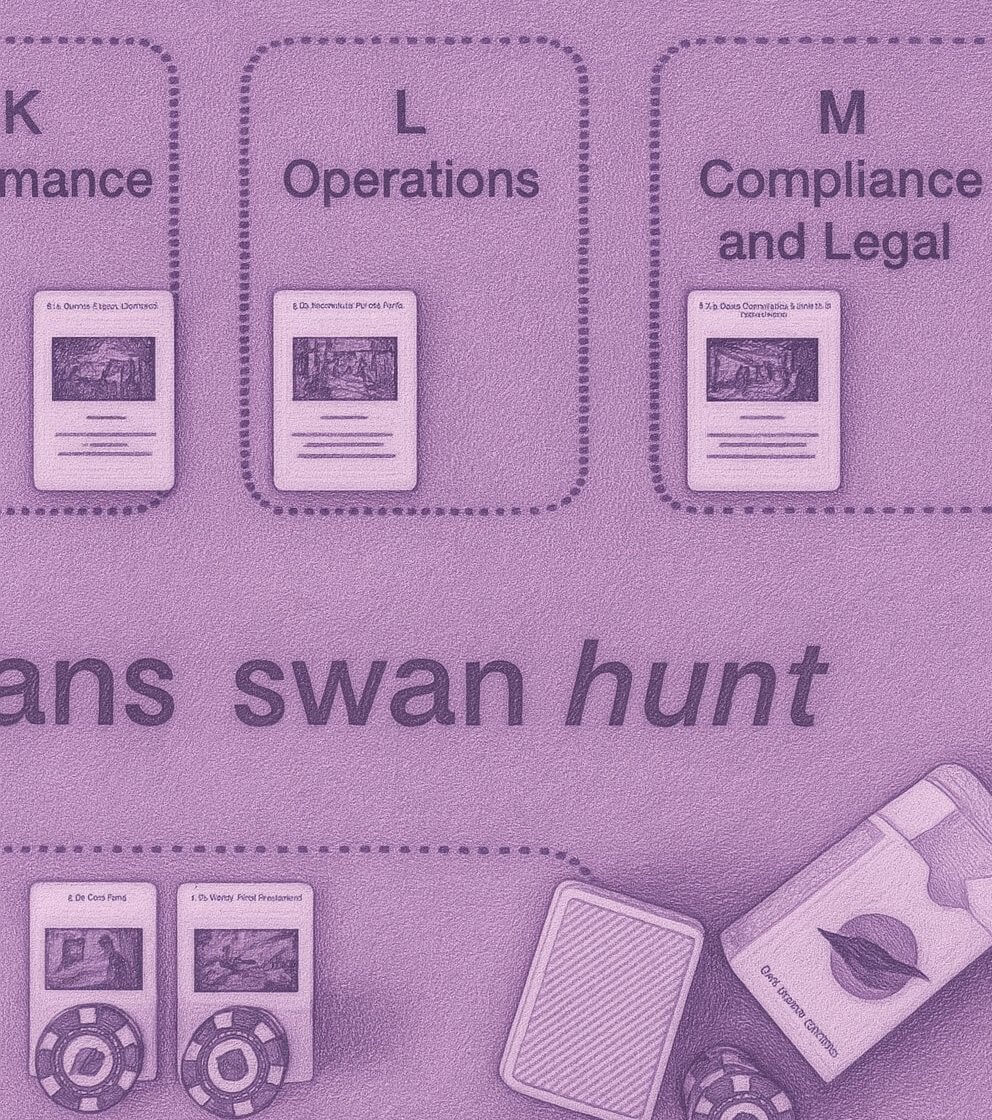
Swan Hunt, developed by The Purple Swans, is an unique threat-hunting game (15, 16). It is built on the premise that fear, when approached deliberately, can be a productive starting point for strategy rather than something to push aside. The underlying Fear-Forward-Model encourages leaders to acknowledge what unsettles them about the future and then ask: if that feared scenario came to pass, how might we respond in a way that creates advantage rather than merely limits damage? (15, 16)
The game draws on a broad database of disruptive threats and proven innovations / ideas from industries, across all sectors and from all over the world, providing a rich set of stimuli. Instead of working from a blank page, leadership teams are confronted with a curated landscape of potential disruptions. Some will be familiar, others uncomfortably new. The point is not to predict the future accurately, but to expand the range of futures leaders can imagine and to force prioritisation.
In a typical Swan Hunt engagement, the leadership team meets in two tightly designed half-day sessions. In the first, they explore and select threats that they believe could be most disruptive to their organisation, debating relevance, timing, and potential impact. In the period between sessions, further analysis may be carried out. In the second, they work on reframing the most significant threats into opportunity spaces: if this were to happen, what would we build, acquire, stop, or radically change? The atmosphere is game-like -there may be teams, rounds, and elements of competition- but the stakes are serious: the organisation’s future posture toward disruption.
What distinguishes Swan Hunt from a generic “brainstorm the future” workshop is the combination of structured content, emotionally honest framing, and strong integration with subsequent decision-making. The output is not a long wish list of ideas; it is a short list of threat–opportunity pairs and corresponding strategic plays that can feed directly into the innovation pipeline, portfolio decisions, and governance processes. Because the game is played by the leadership team itself, the conversation about fear and opportunity takes place at the level where it can actually influence capital and attention.
From a management-dynamics perspective, Swan Hunt encapsulates many of the patterns described earlier. It temporarily flattens hierarchy by inviting everyone in the room to contribute their sense of threat and possibility. It surfaces unspoken fears and assumptions about the external environment. It creates a safe container for exploring unsettling futures. And it translates that exploration into shared narratives about what the organisation must be prepared to do.
Playing the Future Before It Plays You
Games are not a replacement for analysis, governance, or the hard work of execution. They are, however, one of the few tools that can meaningfully shift how leaders think and act together in the face of uncertainty.
By compressing time, they allow organisations to experience the consequences of decisions before committing to them in reality. By making complexity tangible, they help leaders feel the system, not just see its diagrams. By creating shared experiences, they build a common language for talking about risk, opportunity, and trade-offs.
For these reasons, serious games deserve a place in the management toolkit. But they demand respect. Poorly designed or loosely integrated, they can become expensive entertainment. Thoughtfully crafted and anchored in real decisions, they can be catalysts for better strategy, stronger culture, and more honest conversations about the future.
In an era where the unexpected has become routine, it is no longer enough to plan the future on paper. Organisations need spaces where they can play through possible futures together, spaces where they can rehearse responses to disruption, explore the upside of threats, and practise the difficult art of fear-forward strategy. Swan Hunt, by The Purple Swans, is the example of such a space: a structured way for leadership teams to hunt for their most disruptive threats and decide how they will respond.
Ultimately, the choice is simple. Either the future plays itself out on an organisation, catching it unprepared, or the organisation chooses to “play” the future first, in an environment where it can still experiment, learn, and adapt. Serious games, used wisely, tilt the odds toward the latter (1, 2, 6).
References
- De Smale, S., Koivisto, J., & Hamari, J. (2017). The Effect of Simulations and Games on Learning and Motivation in Higher Education. In E. Nygren (Ed.), Serious Games and Edutainment Applications (pp. 449–471). Springer.
- Vélez, A. et al. (2025). Business Simulation Games for the Development of Competences in Higher Education. Education Sciences, 15(2), 168.
- Rahmouni, N. (2025). Exploring the Use of a Business Simulation Game in Certification Programs. In Proceedings of the 17th International Conference on Computer Supported Education.
- Batko, M. (2016). Business Management Simulations – a Detailed Industry Overview. International Journal of Serious Games, 3(3), 47–65.
- Lu, A. S. et al. (2021). Serious games in management education: An acceptance analysis. Management Learning (online first).
- De Souza, M., & Ionescu-Feleagă, L. (2022). Business Simulation Games in Higher Education: A Systematic Review. Education Research International, 2022, 1578791.
- Hinkkanen, L. (2017). Creative Problem Solving with LEGO® Serious Play®. Medium article.
- Innovate-D. (2024). Fostering Creativity Using the LEGO® SERIOUS PLAY® Method.
- PlayStrategy. (2024). LEGO® SERIOUS PLAY® Workshops – From Bricks to Breakthroughs.
- Wikipedia contributors. (2024). Business war games. Wikipedia, The Free Encyclopedia.
- Walton, A. (2024). A Guide to Business Wargaming for Strategic Planning. Competitive Intelligence Alliance.
- CISS / UniBW. (2025). On the Role of Intelligence and Business Wargaming in Competitive Environments. Journal of Strategic Intelligence.
- Terwiesch, C., & Ulrich, K. T. (2009). Innovation Tournaments: Creating and Selecting Exceptional Opportunities. Harvard Business Press.
- Boudreau, K. J., Lacetera, N., & Lakhani, K. R. (2011). Incentives and Problem Uncertainty in Innovation Contests: An Empirical Analysis. Management Science, 57(5), 843–863.
- The Purple Swans & Namaste Management. (2024). Innovation in an Age of Unpredictability. (Fear-Forward Model, Swan Hunt and threat/innovation database).
- The Purple Swans. (2024–2025). LinkedIn posts on Fear-Forward Model and Swan Hunt game.
- Brick Coach. (2024). Unlocking Creativity with LEGO® Serious Play: An Extensive Guide.