
White Paper | October 2025
Authors
Gerard Reumer, Managing Partner
Erikjan Lantink, Partner
Michiel Hofstee, Partner
Executive Summary
Unpredictability is not a transient storm, but the prevailing climate in which modern organizations must learn to thrive. From climate shocks to cyber-extortion, from political volatility to technological leaps, disruption is no longer an anomaly but the very fabric of our environment. Yet most companies are still structured for stability rather than turbulence, a paradigm that urgently needs to shift.
Nearly every organization has faced a material disruption in the past two years [1]. Most executives expect the coming years to bring overlapping crises, yet only a minority believes their organizations can keep pace [2]. The traditional playbook—risk management, resilience frameworks, incremental planning—is failing because it is anchored in the past.
In 2025, 42% of global CEOs say their companies won’t be viable beyond ten years without reinvention, and World Economic Forum identifies conflict and extreme weather as the most urgent near-term risks, evidence that overlapping crises are structural, not episodic [3].
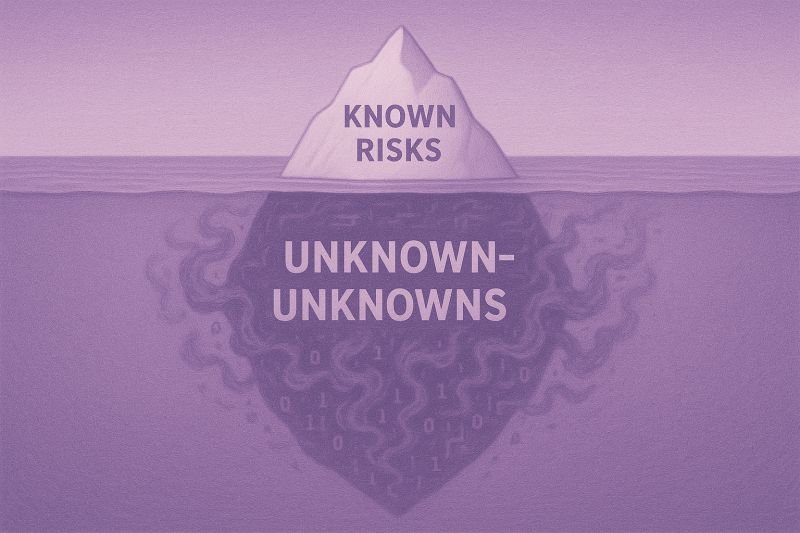
The threats that matter most, branded by The Purple Swans (TPS), as “Purple Swans,” are those we least expect.
The way forward is not to deny fear or suppress uncertainty but to convert fear into fuel. Fear-Forward Growth reframes disruption from a defensive hazard into raw material for innovation, cultural transformation, and outperformance. This transformation is a powerful tool for driving growth and success.
1. The End of Risk Management as We Know It
The world has moved faster than the systems we use to navigate it. Scenario planning traditionally explores a handful of “likely” futures, but when the improbable becomes inevitable, “likely” is too timid a frame.
Disruptions are arriving faster and biting harder than a decade ago. Global supply-chain interruptions now strike roughly every 100 days—triple their historic frequency [4] and cyber-extortion claims jumped 24% in 2024 [5]. Yet 76% of firms admit they still consider too few scenarios in their annual plans, and only one in six has mastered genuinely continuous, agile planning [6].
Consider the container vessel ‘Ever Given’ blocking the Suez Canal in 2021, the LockBit ransomware attack paralyzing Royal Mail in 2023, or the Panama Canal drought throttling global trade. None were anticipated in the plans of the companies affected. All imposed costs are measured in the millions of dollars, but also in trust, reputation, and lost opportunities.
The Ever Given jam delayed ~US$9.6bn of goods per day with 369 ships queued [7]; in 2023 the Panama Canal cut daily transits to 22–24 from a typical ~36 and added US $ 300-500 per container [8]; and Royal Mail’s LockBit attackers demanded ~US$66m, with remediation costs >£10m and a £22 million drop in international-parcel revenue (-6.5% year-on-year). None featured in annual plans, all carried cascading second-order effects.
These incidents underscore a harsh reality: traditional risk management is no longer effective. Its retrospective quantifications are unable to accommodate nonlinear shocks that unpredictably compound. Organizations that persist in using such models will inevitably be caught unprepared. Those that thrive will be the ones that expand their strategic imagination rather than attempting to predict the unpredictable.
2. The Real Cost of Unpreparedness
The financial and operational consequences of disruption are easy enough to measure: ransom payments foregone, surcharges imposed, quarterly revenues that suddenly collapse. But the actual costs are often invisible. They emerge in the erosion of customer trust, the flight of critical talent, the slow bleed of cultural confidence, and the sudden obsolescence of stranded assets.
With more than 70 national elections crowding the 2024 calendar, tariff policy became a moving target. By April 2025 Stellantis, Mercedes-Benz, and Volkswagen had all withdrawn guidance, and Stellantis posted a 14% year-on-year revenue slide in Q1 2025 [9][10].
The Panama Canal drought was not merely a logistical headache; it revealed how fragile global trade remains in the face of environmental volatility. The cyberattack on Royal Mail was not simply a technical failure; it was a reputational wound that will echo in 3 customer relationships for years. These are not one-off crises but previews of a new operating reality.
3. Why Boldness Outperforms Caution
If the risks of disruption are growing, so too are the rewards for those who embrace it.
Companies that lean into uncertainty consistently outperform their peers. Research shows that “future-built” firms generate nearly three times the shareholder return of others, while leaders in artificial intelligence capture substantially more value than laggards[11].
The potential for success is immense for those who abandon rigid, waterfall planning in favor of agility [12].
The conclusion is unmistakable: embracing unpredictability is the most direct path to achieving strategic advantage.
4. Fear-Forward Growth: Turning Fear Into Fuel
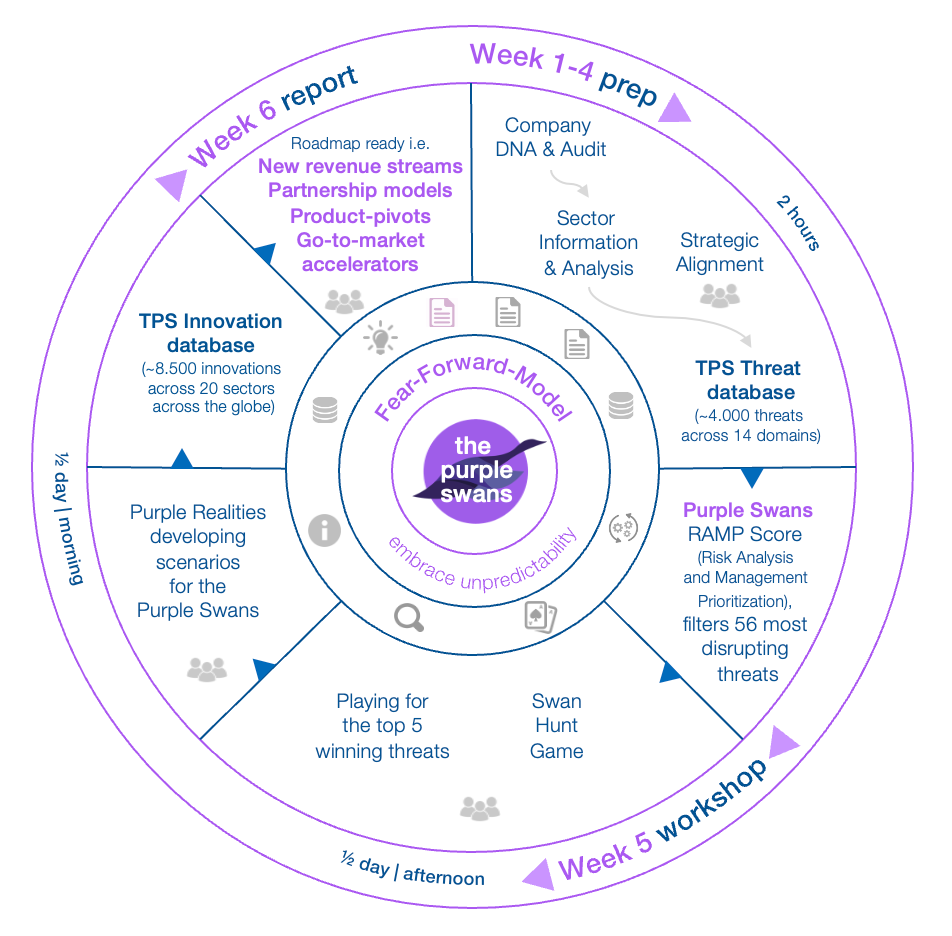
Fear-Forward Growth is a deliberate inversion of the traditional mindset. Instead of treating disruption as a threat to be minimized, it treats it as the raw material of strategic invention. The process begins with a gamified exploration of potential disruptions, called “Purple Swans”, that sit outside conventional planning horizons. It then moves into the creation of “Purple Realities”, immersive narratives of extreme but plausible futures. Finally, the new insights, quantified by TPS’s proprietary Innovation database, are ready to be woven into bold roadmaps that activate new strategies, investments, and innovations.
What distinguishes this approach is not just its mechanics but its philosophy. It does not focus on the probable but on the consequential. It does not seek to defend against disruption but to metabolize it into growth. Most importantly, it does not stop at systems and processes; it transforms the culture of an organization so that fear becomes a source of creativity rather than paralysis.
5. From Resilience to Strategic Fluidity
Organizations that practice Fear-Forward Growth discover something unexpected: disruption ceases to be primarily a danger and becomes a source of strategic advantage. By stress-testing strategies against the most extreme conditions, they reduce waste from failed initiatives and improve the return on innovation. By rehearsing for futures that have not yet arrived, they gain speed to act decisively, whether disruption strikes or opportunities emerge. And by cultivating “strategic liquidity”, a reserve of ideas, alliances, and capabilities, they ensure they are never cornered into a single path.
Purple Swans are not predictions, they are provocations.
This is not resilience in the defensive sense. It is fluidity: the ability to flow into opportunity while competitors are still scrambling to recover.
6. Lessons from the Fear-Forward Leaders
History offers compelling examples of leaders who have thrived by embracing uncertainty rather than resisting it. Nintendo sidestepped the console arms race by inventing an entirely new category of gaming with the Wii. LEGO transformed itself from near-bankruptcy into a $2B+ cultural platform by co-creating with fans spanning film, fashion, and therapy. Patagonia turned climate activism from a marketing message into a business model, winning both purpose-driven customers and robust revenues. And the government of Singapore institutionalized foresight labs and scenario planning inside the Prime Minister’s Office, enabling agile governance and public trust in crises from COVID-19 to climate risk [13].
Each of these organizations saw in disruption not a hazard to minimize but an opportunity to redefine their playing field.
7. Conclusion: The Mindset of the Next Market Leaders
The organizations that will define the next decade will not be those that cling to stability. They will be those who treat volatility as the wind in their sails. By converting fear into fuel, they will attract talent, win investors, and out-innovate competitors who remain trapped in outdated models.
The real question for today’s leaders is not “how do we avoid disruption?” but “how do we grow from it?”
Fear-Forward Growth is not merely a methodology. It is a mindset of the next generation of market leaders.
→ To explore how your leadership team might apply Fear-Forward Growth in practice, contact The Purple Swans for an introductory discussion.
References
- PwC, Global Crisis & Resilience Survey 2023.
- Agility PR Solutions, “Buckle Up CEOs—Expect a Wild Ride in 2024,” Feb 2024.
- World Economic Forum, Global Risks Report 2025.
- KPMG, 2024 Supply Chain Update, Jan 2024.
- World Economic Forum, Global Cybersecurity Outlook 2025.
- The CFO.io, “Ineffective Financial Planning Hits Profitability,” May 2024.
- Al Jazeera, “Suez Canal Blockage Halts $9.6 bn a Day of Ship Traffic,” 25 Mar 2021.
- Bloomberg, “Panama Canal Imposes New Shipping Restrictions for Drought,” 19 May 2023.
- Reuters, “Stellantis Suspends Full-Year Forecasts over Tariff Uncertainty,” 30 Apr 2025.
- Stellantis, “First-Quarter 2025 Shipments and Revenues,” Press Release, Apr 2025.
- Boston Consulting Group, “Companies Built for the Future Generate 3× TSR,” Apr 2023.
- Businessmap, “Agile Statistics 2025.”
- OECD Working Papers on Public Governance No. 44, 24 December 2020