

Unpredictability: the defining threat to modern organizations
Purple Paper | December 2025
The Purple Swans© | Gerard Reumer, managing partner | Erikjan Lantink, partner | Michiel Hofstee, partner
Executive summary
Across boardrooms and C-suites, one theme keeps surfacing: the world no longer behaves in ways that feel forecastable.
CEO’s consistently rank various forms of uncertainty, such as economic volatility, geopolitical instability, rapid technological change and climate-related disruption, as their most serious external threats. KPMG concludes [1], that economic uncertainty emerges as CEOs’ top external threat to growth and Russell Reynolds comes to the same conclusion in its 2025 Global Leadership Monitor. This study finds that it is the leading external factor affecting organizational health, with rapid technological change (particularly AI) a close second. [2]
Meanwhile, nearly half of CEO’s globally doubt their current business would still be viable in ten years if it stays on its present course, largely because of technology and climate pressures. [3] That is an extraordinary admission: leaders no longer question whether disruption will come, but whether their existing organizations can survive it.
This Purple Paper zooms in on unpredictability itself — not on solutions or tools, but on how this structural feature of today’s environment is reshaping organizations and leadership. It will answer questions as to why volatility has shifted from episodic “shocks” to a continuous operating condition. Why different risk domains (political, environmental, technological, cyber, economic, social) are increasingly interconnected, amplifying unpredictability. How this reality plays out inside organizations: in strategy cycles, decision-making, innovation capacity, culture, mental load and governance. And what this means for leaders’ attention, time and psychological bandwidth.
The goal is understanding, not comfort. Unpredictability is not just more noise around the edges of a familiar system; it is changing the system itself.
1. From volatility to structural unpredictability
1.1 Beyond “bad weather”
For decades, global business has talked about VUCA (volatility, uncertainty, complexity, ambiguity). What has changed in the last 5–10 years is not just the level of volatility, but its structure. Shocks no longer arrive in isolation. For instance, a geopolitical conflict shifts energy prices, which feeds inflation, which drives political instability, which triggers regulatory change and which reshapes supply chains. The gap between signal and impact shrinks: a technological breakthrough, a viral campaign, a regulatory ruling or a cyber incident can materially change a business context within weeks.
The Global Risks Reports of the World Economic Forum capture this shift. Recent editions highlight how rapid tech change, economic uncertainty, climate-related extremes, and geopolitical conflict interact in ways that stretch governance systems beyond their limit. [4]
This is less like forecasting weather and more like operating-inside-a-storm-system: the organization is part of the turbulence, not seeing it from a distance.
1.2 From risk to uncertainty
Classic Risk Analysis and -Management assumes that you can describe possible events, estimate their likelihood and that you can attach (financial) impacts.
In many emerging domains (e.g. AI, cyber, (geo)political, climate) those assumptions break down. Leaders face true uncertainty, where probability distributions are unclear or unstable. AI systems can create new forms of misinformation, fraud or operational dependence that do not yet have historical patterns. [5]
Climate-related risks combine acute events (floods, heatwaves) with chronic shifts (water stress, regulation, transition costs) that unfold over very different timescales. [6] Geopolitical alignments and trade regimes can shift rapidly, creating regulatory and supply chain breaks that were not present in the “training data” of past decisions. [4]
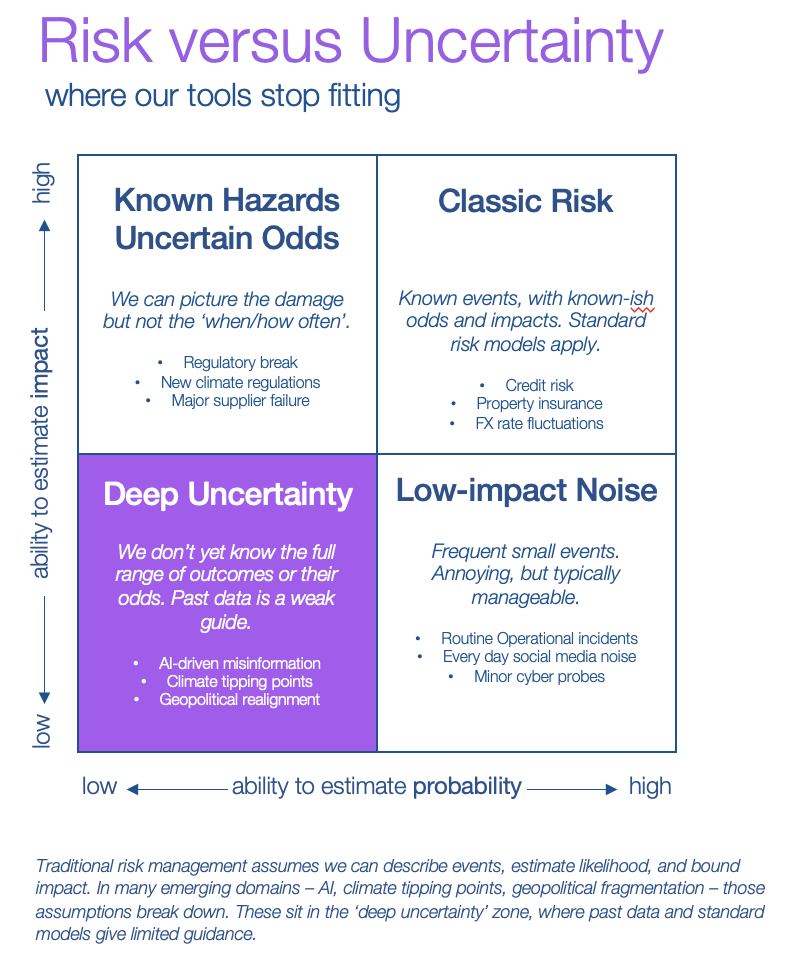
This uncertainty is what many leaders now see as the main story of the external environment.
2. The external drivers of unpredictability
Unpredictability is not one phenomenon. It is the combined effect of overlapping risk domains. For organizations, the most important feature is interdependence: a shock in one domain propagates quickly into others.
2.1 Geopolitics and the fragmentation of the global order
Executives increasingly see geopolitical and political uncertainty as a primary risk to growth. In 2023 KPMG found geopolitics and political uncertainty had become the leading perceived risk for senior executives worldwide, while it did not even appear in the top five the year before. [7]
Implications for organizations are significant. They can experience a regulatory whiplash. Sudden sanctions, data-localization rules, trade restrictions or foreign investment controls can invalidate existing strategies overnight. The just-in-time global supply models may prove brittle when shipping lanes, borders or energy routes are disrupted. And strategy teams must consider a much wider range of geopolitical futures, with less consensus on “base-case” assumptions.
Geopolitics today is not background-noise; it is an active variable in revenue forecasts, capital allocation and even organizational structure.
2.2 Climate and environmental instability
The climate crisis contributes to unpredictability on multiple fronts. Extreme weather is frequently ranked among the top global risks likely to trigger material crises. [8] Carbon pricing, disclosure requirements and sector-specific regulations reshape business models, sometimes faster than investment cycles allow, [6] and litigation, activist pressure and shifting customer expectations create non-linear reputation shocks.
For leaders, climate is not simply an environmental issue but a source of cascading uncertainty: energy prices, insurance availability, regulatory pathways and market preferences all move together in ways that are hard to forecast.
2.3 Technological disruption and AI
Technological change has always disrupted industries, but the current wave, particularly AI, introduces a more fluid, less predictable environment. PwC’s 2024 CEO survey reports that 70% of CEOs expect generative AI to significantly change how their company creates value in the next three years. [3] At the same time, CEOs worry about AI-driven cyber risk, misinformation and workforce disruption, creating both opportunity and threat in one package. [9]
Leaders are confronted with two uncertainties. The pace of adoption. How quickly will competitors, regulators, and ecosystems change? And the direction of impact. Which parts of the value chain will be automated, augmented or newly created?
The result is heightened pressure to act before the environment stabilizes, which, paradoxically, it may never do.
2.4 Cyber threats and digital dependence
As organizations digitize operations and rely on interconnected systems, the impact of cyber incidents becomes both more severe and more difficult to contain.
Boards increasingly see cybersecurity and data protection as central to business resilience, not just IT hygiene. [3] A single breach can set off regulatory investigations, operational paralysis, customer churn and reputational damage across multiple markets.
The difficulty is not just preventing events but operating in a world where unknown vulnerabilities may be embedded in critical systems and where attackers can innovate as fast as or faster than defenders.
2.5 Economic volatility and financial conditions
After a long period of relatively low interest rates and stable inflation, organizations now face a more erratic macro environment.
PwC cites macroeconomic volatility as the threat most likely to cause significant financial loss in the coming year. [10] Russell Reynolds shows uncertain economic growth as the top external factor affecting organizational health, often outranking cyber threats, regulation, and technological change. [2]
For organizations, this means assumptions about cost of capital and demand are shorter-lived. They will have greater difficulty making long-term commitments to capacity, M&A or innovation portfolios. And there may be sharp reversals in investor sentiment and access to funding.
2.6 Social polarization, misinformation and trust
The information environment itself is becoming a driver of unpredictability. The WEF names misinformation and disinformation as the most severe short-term global risk, ahead of many traditional economic or environmental threats. [5] Their analysis highlights how misperceptions of risk can undermine resilience: leaders and societies may focus on the wrong threats or underestimate compounding risks. [6]
For organizations, this shows up as Increased reputational volatility. Narratives about companies, sectors, or leaders can shift rapidly, often untethered from underlying fundamentals. Polarized societies can bleed into the workplace, complicating culture, inclusion, and communication causing enhanced internal friction. Regulators respond to public pressure with new rules, often on fast and unpredictable timelines, creating more governance complexity.
3. How unpredictability manifests inside organizations
Unpredictability is not just a description of the outside world. It produces recognizable patterns inside companies — many of which leaders can feel but struggle to name.
3.1 Strategy cycles: from five-year plans to permanent revision
Several CEO surveys now talk explicitly about an “imperative to reinvent.” PwC notes that 97% of CEO’s report making changes to how they create, deliver, or capture value due to accelerating trends such as technological disruption and climate change. [3]
Inside organizations, this often looks like shrinking planning horizons where five-year strategies still exist on paper, but real decisions are made in rolling 12-24-month-cycles; strategy decay as strategic assumptions “age” faster; insights lose value sooner; and scenario overload with teams developing multiple scenario sets (economic, geopolitical, technological), each with different triggers and implications, creating cognitive overload rather than clarity.
Leaders are not simply updating plans more often. They are trying to steer organizations where the half-life of confidence in any given plan is much shorter.
3.2 Decision-making under time compression
Unpredictability compresses time in multiple ways: external shocks arrive faster than decision forums (board meetings, annual budgeting) are designed to handle; data streams multiply, but interpretation time does not; and stakeholders (investors, regulators, employees, media) expect visible responses quickly.
Common internal symptoms include decision bottlenecks where a small group of leaders is drawn into every critical choice “just in case”, creating delays and burnout; oscillation, as teams pivot repeatedly as new information emerges, reducing follow-through and eroding trust in decisions; and shadow decision-making in which informal networks make rapid calls outside formal processes, which can be effective but undermine transparency and governance.
Decision quality becomes a function not just of analysis, but of how well the organization handles pressure, ambiguity and incomplete information.
3.3 The innovation squeeze
Unpredictability creates a paradox for innovation: on one hand, the need to reinvent is widely acknowledged. Almost half of CEO’s doubt their current business will be viable in ten years without significant transformation [3], while on the other hand, volatility encourages defensive behaviors: cost control, risk avoidance, “wait-and-see” attitudes.
Internally, this often leads to stop-start investment patterns, where innovation budgets expand in optimistic cycles and are cut at the first sign of trouble, preventing compounding learning; pilot proliferation, value scarcity: organizations run many small experiments but struggle to scale, because context keeps shifting and risk appetite is low; and talent frustration, as innovators and high-potential leaders experience “initiative-fatigue” when transformations are launched, rebranded, and abandoned in rapid succession.
Over time, unpredictability can erode innovation culture, even as leaders talk more about transformation.
3.4 Culture and wellbeing: chronic uncertainty as a workplace condition
Extended exposure to unpredictability changes how people feel at work: employees experience constant context-switching; new priorities, new risks, new “urgent” initiatives; the boundary between global-crises and work-life blurs; conflicts, climate events and social tensions show up in daily conversations and hybrid and digital work amplify both flexibility and ambient anxiety.
For organizations, common patterns include elevated burnout and disengagement, especially among middle managers who must translate shifting strategies into operational reality; defensive cultures where people protect themselves by minimizing exposure to blame rather than creating value. And a silent narrowing of ambition: teams aim for “good enough to not get criticized” rather than bold outcomes.
Unpredictability becomes not just a strategic challenge but a human sustainability issue.
3.5 Governance and risk: from lists to webs
Traditional risk management often assume independent categories with individual owners. But in a world of interconnected risks, boards and executive committees struggle with risk interdependencies, for example a cyber-attack triggered by geopolitical tension, amplified by misinformation, leading to regulatory inquiry and financial loss.
Risk functions can become either overextended as they try to own everything, or marginalized, when they are seen as blockers rather than enablers, and reporting systems lag reality; by the time a risk is formally documented and scored, its nature may have shifted.
Zurich’s analysis of global risk perceptions underscores a further complication: misaligned perceptions between leaders and underlying data can undermine resilience, as organizations over- or under-index on the wrong threats. [6]
This calls into question not just which risks are tracked, but how organizations sense, interpret, and debate them.
4. The leadership experience in an age of unpredictability
Unpredictability is not abstract for leaders; it shows up in their calendars, inboxes and sleeping patterns.
4.1 CEO’s: optimism about growth | anxiety about viability
Recent CEO surveys show a nuanced picture: many CEO’s are more optimistic about short-term global growth than in previous years, with PWC reporting that nearly 60% now expect global economic growth to improve over the coming year. [11] Simultaneously, 45% of CEO’s doubt their business will be viable in a decade without major reinvention, driven largely by technology and climate pressures. [3] EY finds that 57% of CEO’s expect geopolitical and economic uncertainty to persist well beyond the next 12 months [12] and KPMG shows economic uncertainty as the top threat across domains, reinforcing the centrality of unpredictability in leadership thinking. [1]
In other words, CEO’s are cyclically optimistic, but structurally worried. They believe they can perform in the near term but are less confident their current organizations are fit for the future.
This tension creates a distinctive leadership experience: leaders must deliver strong quarterly and annual results now, while simultaneously questioning whether today’s successful model can — or should — survive.
4.2 Cognitive load and attention fragmentation
Unpredictability increases the cognitive demands on leaders. The number of domains they must track (geopolitics, regulation, climate, AI, social movements, etc.) expands and each domain evolves faster, with less stable expert consensus. On top of that the signals often conflict and the cost of misreading them can be high.
Leaders’ attention becomes fragmented as board meetings are packed with urgent updates, leaving less room for deep discussion. At the same time, external stakeholders (investors, regulators, media, NGO’s) pull leaders into multiple narratives simultaneously. Internally, expectations are on the rise as employees want clear direction and meaning in a world that feels confusing.
The result can be decision fatigue and a tendency toward either hyperactivity (many initiatives, shallow follow-through) or paralysis (endless analysis, delayed commitment).
4.3 Emotional climate and identity
Leadership identity has historically been rooted in predictability: the ability to develop a plan, make promises, and keep them. In a structurally unpredictable world, that identity is under pressure.
Many leaders describe as sense of being in a permanent state of provisionality: where every decision is a “best current guess” subject to revision, alongside the emotional toll of being expected to provide certainty to others while having less of it themselves, and increased exposure to public scrutiny in an era of social media, activist investors and politicized debates.
The AP’s coverage of recent CEO surveys notes that leaders are simultaneously excited about AI and climate-driven opportunities and worried about how badly managed innovation and polarization might fragment societies — and therefore markets. [9]
This emotional complexity can translate into overcompensation. Leaders may swing toward overconfident communication, offering narratives that are out of sync with reality. Or they may lean toward under-communication, withholding their perspective to avoid being wrong. This dynamic often fuels tension within top teams as different leaders hold different implicit “mental models” of the future.
4.4 Boards and top teams: alignment under uncertainty
Boards and executive teams operate at the intersection of long-term responsibility and short-term turbulence. Unpredictability stresses this interface in several ways. Different risk tolerances: some directors and executives have more appetite for bold reinvention, others for preservation; unpredictability can magnify these differences.
Conflicting time horizons also complicate things, with investors, regulators and employees each prioritizing different timeframes, making trade-offs harder. At the same time, information asymmetries persist; management has more real-time data, while boards have broader external perspective, leaving both sides partially right and partially wrong.
Russell Reynolds’ ongoing tracking of leadership concerns highlights how uncertain economic growth and talent availability stay top of mind while other threats (e.g. cyber, regulation, geopolitical uncertainty, tech change) cycle in and out of the top tier. [2]
This churn of perceived priorities can strain alignment at the top if there is no shared language for unpredictability itself.
5. Organizational patterns and unintended consequences
When unpredictability is chronic, organizations develop recurring patterns of response. Some are adaptive; many are not. Here we discuss a few common ones.
5.1 Permanent crisis mode
Teams operate as if every issue is existential and urgent. Short-term firefighting dominates agendas, Strategic work is repeatedly postponed or squeezed into thin slices of time, and leaders’ presence is constantly demanded, making it hard to delegate and develop successors.
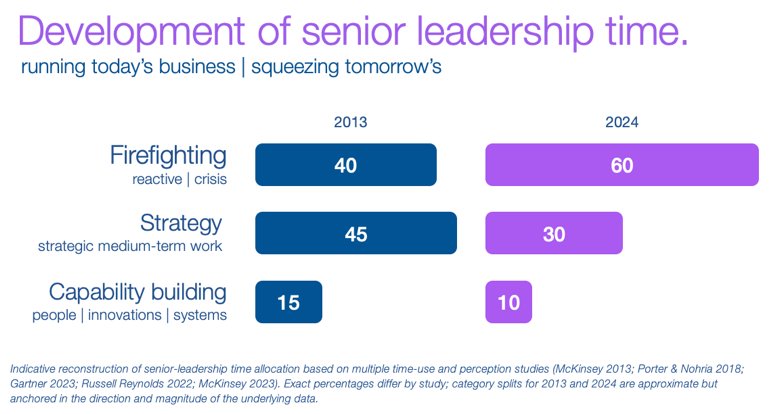
Over time, permanent crisis mode degrades resilience: people burn out, mistakes increase, and the organization becomes less capable of responding when true crises occur.
5.2 Short-termism disguised as prudence
Under pressure, organizations often raise hurdle rates for long-term investments, especially in innovation and transformation and default to projects with fast payback, even when the medium-term risk of inaction is high. They then communicate caution in the language of “discipline” and “risk management,” masking a deeper retreat from bolder bets.
This can be rational in the short run, but in an environment where many CEO’s already doubt their business model’s long-term viability, chronic short-termism can be a form of risk-seeking by omission: betting the future on incremental optimization.
5.3 Procedural escalation
To cope with unpredictability, organizations add more governance forums, more approval steps and more reporting requirements.
Initially meant to improve oversight, this often results in slower decision-making-cycles, lower ownership at the edges of the organization and more opportunities for “safe” avoidance of responsibility. In fast-changing contexts, over-governance can increase risk by preventing timely adaptation.
5.4 Cultural drift toward defensiveness
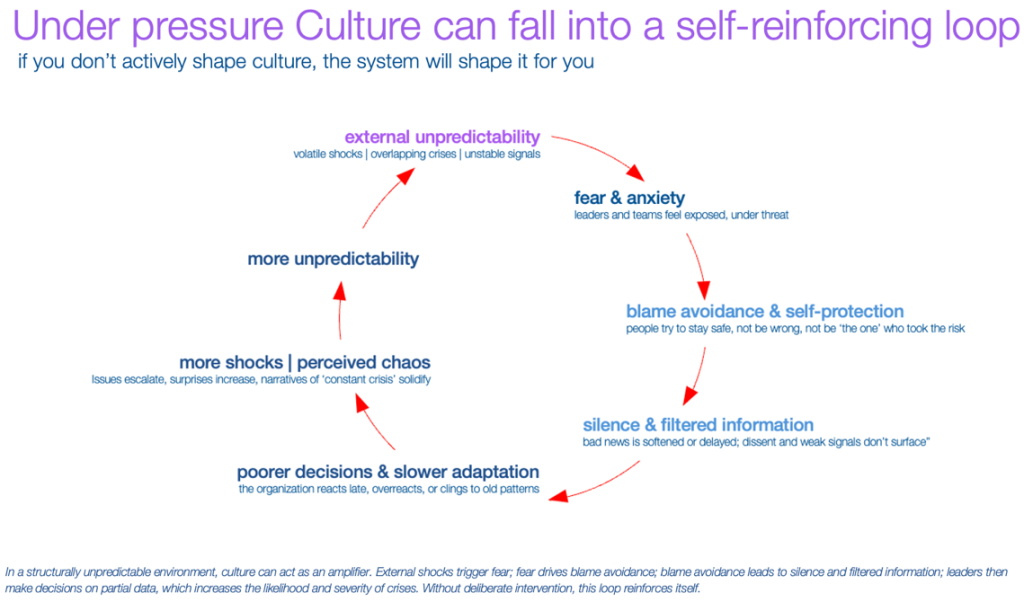
When the external world feels dangerous and unpredictable, internal culture can drift toward blame avoidance, focusing on “who signed off on this?” rather than shared learning and silence around bad news, as messengers avoid becoming targets. At the same time, organizations may lean too heavily on precedent, insisting “we handled it this way last time.” even when conditions have changed.
Ironically, in an unpredictable world, the most dangerous internal pattern is the erosion of honest conversation — precisely when organizations need it most.
6. Questions for boards and leaders in an unpredictable world
This Purple Paper has intentionally focused on understanding unpredictability, not prescribing solutions. Still, leaders grappling with these dynamics may benefit from holding a set of questions:
- About context
- What forms of unpredictability (economic, geopolitical, technological, environmental, social) most materially shape our context — and how do they interact?
- Where are our assumptions about the future most fragile or least tested?
- About strategy
- How quickly do our core strategic assumptions “expire” in this environment?
- How often do we deliberately revisit them, and on what triggers?
- About leadership
- How is unpredictability showing up in the lived experience of our leadership team and board — cognitively, emotionally, and relationally?
- Do we have a shared language for talking about uncertainty, or is it fragmented across functions (risk, strategy, finance, technology)?
- About organization and culture
- Where are we seeing signs of permanent crisis mode, innovation squeeze, or defensive culture?
- How honestly can people talk about external uncertainty without fear of being labeled negative or disloyal?
- About risk and resilience
- Are our risk processes designed for interconnected, fast-moving risks — or for a more linear, predictable world?
- How do we detect and challenge misperceptions of risk inside our own leadership system?
These questions do not resolve unpredictability. But they help leaders see it more clearly — as a structural feature of their environment rather than a temporary disturbance.
Understanding unpredictability in this way is a precondition for any meaningful strategic or organizational response. Without that shared understanding, even well-designed solutions risk being misapplied, underpowered, or abandoned at the first sign of the next shock.
About The Purple Swans
The Purple Swans understand unpredictability, but don’t view it as a threat – the threat is missing the opportunities inside it. The Purple Swans combine the “black swan” idea – rare, disruptive events – with purple, the color of imagination. Where black swans signal surprise and massive shocks, purple adds creative possibility. Together TPS stands for turning the unpredictable into inventive advantage: elegant like a swan, bold in color, and built to navigate — and shape — uncertainty.
the purple swans© embrace unpredictability
info@thepurpleswans.com | www.thepurpleswans.com
Endnotes
[1] KPMG, Global CEO Outlook 2025 – survey of CEOs on growth prospects, risks, and economic uncertainty.
[2] KPMG & Russell Reynolds Associates, 2025 Global Leadership Monitor and related Russell Reynolds leadership research – findings on uncertain economic growth, leadership concerns, and external threats to organizational health.
[3] PwC, Global CEO Survey 2024 – global survey highlighting CEOs’ views on business model viability, reinvention, macro uncertainty, and generative AI.
[4] World Economic Forum, Global Risks Reports (recent editions) – analysis of how technological, economic, climate and geopolitical risks interact to strain governance systems.
[5] World Economic Forum, Global Risks Report 2024 – in-depth treatment of AI, misinformation/disinformation, and other emerging risks shaping the global outlook.
[6] Zurich Insurance Group, global risk and resilience analyses (often in collaboration with the World Economic Forum) – including work on climate-related risks and misperceptions of risk.
[7] KPMG, 2023 CEO Outlook – findings on the rise of geopolitical and political uncertainty as a primary risk to growth, as summarized in external coverage.
[8] Climate Action – coverage of global risk rankings emphasizing extreme weather as a leading trigger of material crises.
[9] Associated Press (AP News) – reporting on recent CEO surveys regarding AI, climate-related opportunities, and the risks of polarization and fragmentation.
[10] PwC, 2025 CEO Survey / CEO Outlook – analysis of macroeconomic volatility as the top business threat likely to cause significant financial loss.
[11] Reuters – coverage of PwC’s CEO survey results indicating that most CEOs expect global economic growth to improve over the coming year.
[12] EY, 2025 CEO Outlook – survey of CEOs’ expectations that geopolitical and economic uncertainty will persist well beyond the next 12 months.